The unexpected acolytes helping to keep ninja heritage alive
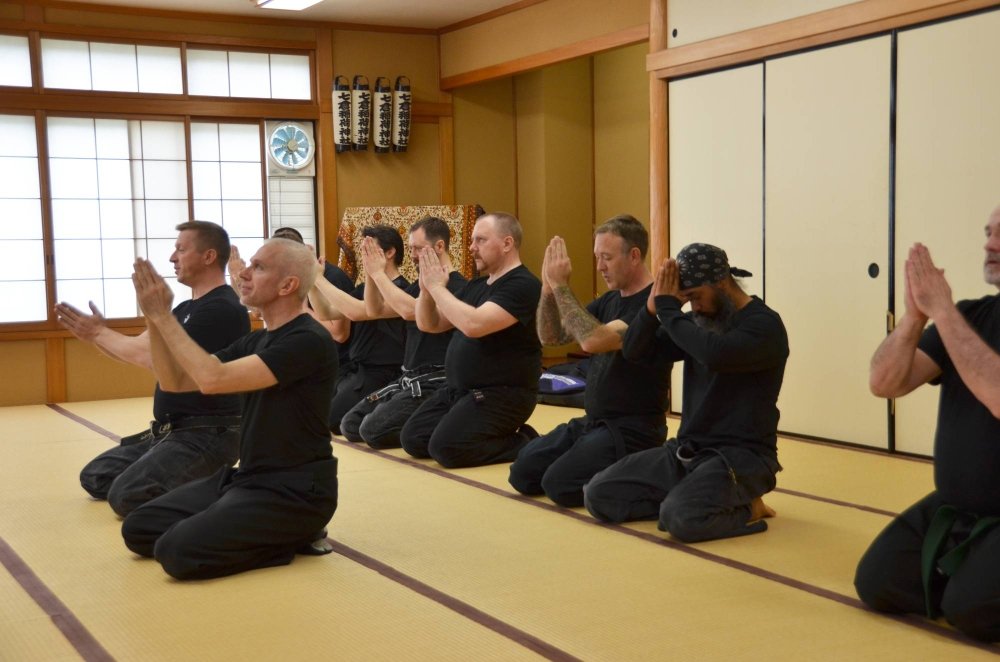
Dressed in black martial arts uniforms and wearing split-toed tabi footwear, around 60 students are performing various grappling and throwing techniques inside the 520-square-meter Budojo 1 at the Tokyo Budokan, a massive martial arts arena in the Ayase area of Adachi Ward.
The venue hosts a wide variety of martial arts training, but when I visited one night years ago, the tatami-floored Budojo 1 was entirely dedicated to the Bujinkan, an organization that is most strongly associated with authentic ninjutsu, the combat and stealth techniques used by ninja.
That night, the students were under the watchful eye of Bujinkan founder Masaaki Hatsumi. He presided over a sakki test, in which students deemed “ready” had to sit with their eyes closed and evade a strike from a bamboo sword — some succeed to considerable collective excitement. One thing that stuck out about the class, though: Despite a handful of Asian faces, the ninja student body was largely a sea of white men.
Fictional ninja portrayals on TV and in film have led to people traveling to Tokyo to live out the ninja dreams of their youth, but what has become of these figures inside Japan? Beyond being a feudal-era relic and staple of pop culture, who is keeping their legacy alive?
Hatsumi, now 92, no longer teaches. When I first met him, though, his hair was dyed purple and he defied the stereotype of a stern instructor. He was more like an extroverted international entrepreneur (he even spoke a few words of my native Swedish to me, having trained in Sweden several times).
For Hatsumi, this dojo full of foreign ninja-in-training was no accident — it was a situation he had cultivated throughout his career.
A foreign reality
It might seem peculiar that Hatsumi, the 34th sōke (grandmaster) of Togakure-ryu ninjutsu and head of the nine martial lineages collectively known as the Bujinkan has intentionally focused on an international student base for decades, but according to Pete Reynolds, a 57-year-old American who has trained with the Bujinkan for 38 years, it isn’t.
“Hatsumi-sensei has overwhelmingly taught to a non-Japanese student base, and in my experience, it’s not unique to the Bujinkan,” says Reynolds, a daishihan (senior instructor) and head of Bujinkan’s Nezu dojo. “Generally speaking, most Japanese people see martial arts as antiquated and even a bit uncool. It’s often taken for granted here because it originates from this place and is associated with ancient culture.”

Masaaki Hatsumi is the founder of Bujinkan, an organization that teaches skills and techniques derived from Japan’s iconic ninja. | ERIK AUGUSTIN PALM
Reynolds has lived in Tokyo since 2000, but he grew up in Florida, where he experimented with various martial arts without finding one that met his need for an integrated philosophical and physical approach. After high school, a friend introduced him to the books of Stephen Hayes, an American who had spent years training in Japan with Hatsumi. Reynolds attended a seminar by the author, where he met his first Bujinkan teacher in 1986. Fourteen years later, Reynolds moved to Tokyo to train directly with Hatsumi, and in 2007, with his mentor’s approval, Reynolds established his own dojo catering to foreign students in Nezu.
Reynolds has trained there weekly ever since. He lives in the same neighborhood with his wife, who is a senior manager at a foreign bank, and their kids. Reynolds himself has been able to retire early to become a stay-at-home dad, but he notes that there is no aspect of financial gain when it comes to his dojo. I asked him about the scope of the Bujinkan’s operations in Japan and worldwide. Reynolds estimates that there are probably up to 400 active students in the country, but significantly more internationally — “almost certainly more than 500,000.”
“In the West, I think that martial arts are much more respected and venerated because they are unique and from outside Westerners’ own cultures, and demand focus and discipline,” he says. “The most extreme examples of that difference are people who actually travel or even move here to study Japanese martial arts such as the Bujinkan. Those people are demonstrably much more dedicated and have made martial arts a part of their entire lives and identities.”
Ninja in academia
While ninja are a major draw overseas, there are still some Japanese people who are dedicating their lives to the shinobi’s legacy. In 2020, for example, 45-year-old Genichi Mitsuhashi became the first person in the world to earn a master’s degree in “ninja studies” from Mie University.
The two-year postgraduate course — involving lessons in ninja history, basic ninja techniques and survival skills — is organized by the International Ninja Research Center. The center is located in Iga, Mie Prefecture, one of the primary birthplaces of the ninja, where ninjutsu practices emerged during the 15th century.
“We want to advance academic and interdisciplinary research activities on ninjas, educational activities based on ninja research and academic information exchange and dissemination activities about ninja,” explains deputy director Yuji Yamada.
Besides Mitsuhashi, seven people have by now been awarded a master’s degree in ninja studies — in 2024, four students are currently enrolled.
“The course involves reading ancient documents, so a very high proficiency in Japanese is required,” says Yamada. Meaning, perhaps, that although it doesn’t exclude non-Japanese speakers from a master’s degree in ninja studies, this condition makes it less likely.

Members of the Bujinkan train at the Tokyo Budokan in Adachi Ward. | ERIK AUGUSTIN PALM
Still, Yamada seconds Reynolds’ perception that non-Japanese people are heavily interested in the practice of martial arts.
“There are many foreigners who are interested in and practice martial arts, and I think many of them are more ambitious and enthusiastic than the Japanese,” he says. “As many schools are at risk of dying out, these foreigners can help keep these traditions alive.”
Iga’s ambivalent ninja heritage
The simple existence of the International Ninja Research Center proves there is a will in the region to honor its ninja history. Yamada emphasizes that in Iga — as well as in other sites of ninja origin, such as Koga, Shiga Prefecture — there is diligent preservation of the homes of ninja, mountain castles where they held out, and their makimono (scrolls), which document practices and techniques.
However, as with any other element of Japanese culture, ninja are just as susceptible to tokenization. A trip to the rural community of Iga will reveal ninja-themed trains and the small Ninja Museum of Igaryu. There, “ninja” in pink attire demonstrate the workings of secret entrances and trap doors, perform half-hearted fight choreography and throw shuriken (throwing stars) in somewhat unkempt premises.
An anticlimactic experience tailored to bucket-list tourism, the museum may very well have improved since my last visit several years ago, but the sense I got of how it diminished the ninja took on a deeper meaning when I learned its honorary director is Jinichi Kawakami. He’s around 75 years old, and claims to be the 21st head of the Koga Ban family and the last sōke and sole heir to authentic ninjutsu. Kawakami was also appointed as a ninjutsu research professor at Mie University in 2011.
But in 2012, he decided he would not pass on his teachings since he believes “ninjutsu has no place in the modern age.” The last Japanese ninja — or at least one of them (Kawakami’s title has been questioned but not disproved) — has decided there should be no more Japanese ninja. That they should remain in the past.
It’s worth noting that Hatsumi has not appointed an official heir to his overarching sōke title of all nine schools. But he has named Japanese successors for each of his nine schools, all of whom train in the Bujinkan dojo in Noda.
Cultural preservation
Many Western expats in Japan might cringe at the thought of a starry-eyed, 20-something American moving here to pursue their ninja dreams. Yet, here we are — in a world where those new arrivals are valued as custodians of the heritage. And the involvement of non-Japanese practitioners in ninja-related martial arts arguably does more than just keep these techniques alive; it helps connect Japan and the world.
While the efforts of Mie University’s ninja center are crucial for historicizing this icon of Japanese culture, Reynolds and his peers’ involvement in Bujinkan keeps the spirit and techniques of the ninja adaptable and relevant on a global scale. Importantly, their goal is not to become assassins but to excel both in life and in the dojo. Reynolds claims that what Hatsumi has been teaching and sharing with him has become part of nearly every aspect of the way he lives his life.

Pete Reynolds, a senior instructor or “daishihan” at Bujinkan’s Nezu dojo, teaches students ninjutsu techniques. | ERIK AUGUSTIN PALM
“There really isn’t anything I can think of that it hasn’t touched in some way, shape, or form, from the way that I approach relationships to how I ride a bicycle,” he says. “What Hatsumi-sensei has shared is an integral part of my core life philosophy. As such, I do my best to be a living example of that for my children, those that train with me, and society as a whole.”












Post Comment