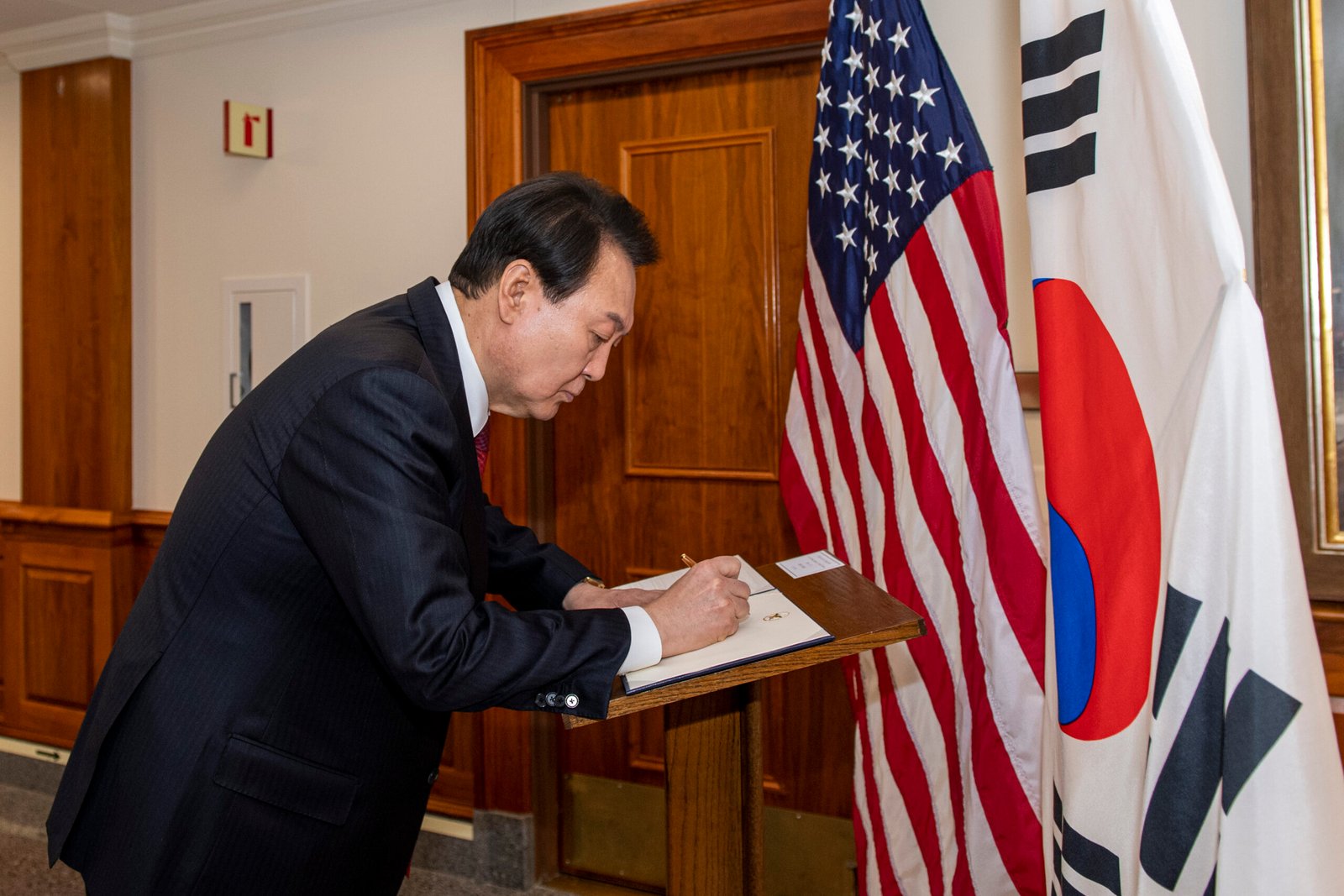
South Korea’s Impeached President Faces Detention Amid Political Turmoil
- South Korea’s impeached President Yoon Suk Yeol faces detention as military unit allows police and anti-corruption agency officials entry.
- The Presidential Security Service (PSS) previously thwarted an attempt to detain Yoon, citing legality concerns.
- The political turmoil has international implications, with North Korea launching missiles amidst the chaos.
- The situation mirrors the Watergate scandal, highlighting the delicate balance between power and accountability in democracies.
In a significant development in South Korea’s political landscape, a military unit guarding the presidential residence has given the green light for the entry of police and anti-corruption agency officials. The move is aimed at detaining the impeached South Korean President Yoon Suk Yeol. The Corruption Investigation Office for High-ranking Officials (CIO) had requested access to the presidential residence, a request that was granted by the unit under the Capital Defence Command. This unit is tasked with the responsibility of guarding the exterior of the presidential residence, a fact reported by the Yonhap news agency.
This approval is expected to facilitate the second attempt by police and CIO officials to detain Yoon, which is anticipated to occur early Wednesday. The first attempt to detain Yoon was thwarted by the Presidential Security Service (PSS) on January 3, raising questions about the legality of the process. The PSS had earlier raised concerns about a second attempt to detain Yoon, stating that a forced entry into Yoon’s residence would be illegal and that it would respond in accordance with its security protocols.
Legal and Political Complexities Surrounding the Detention
The PSS issued a statement after a meeting with the police and the CIO to discuss the execution of Yoon’s arrest warrant over his short-lived imposition of martial law. The PSS has emphasized that specific security areas, including the presidential residence, are designated as security zones, national security facilities, critical national facilities, and military protection zones. Entry into these areas requires prior approval from the responsible authority, and forced entry would be considered illegal.
South Korea has been plunged into a period of political uncertainty following Yoon’s martial law declaration on December 3, 2024, and his subsequent impeachment on December 14, 2024. The PSS has pledged to make efforts to prevent any clashes during the warrant’s execution, indicating a commitment to maintaining order during this politically charged period.
However, the situation is further complicated by the fact that a senior official at the PSS failed to appear for police questioning on Monday, defying a summons for the third time. This has led to the police planning to file an arrest warrant for the official, citing his flight risk.
International Implications and Historical Parallels
The political turmoil in South Korea has also had international implications. Amid the chaos, North Korea launched several short-range ballistic missiles, coinciding with a visit to Seoul by Japanese Foreign Minister Takeshi Iwaya, and less than a week before U.S. President-elect Donald Trump takes office.
The situation bears some resemblance to the Watergate scandal in the United States in the 1970s, where President Richard Nixon was implicated in a cover-up of a break-in at the Democratic National Committee headquarters. Nixon eventually resigned before he could be impeached, marking a significant moment in American political history.






Post Comment