Asian Stocks Fluctuate Amid Global Market Volatility
Asian stocks experienced a mixed performance on Tuesday, following the Dow Jones Industrial Average’s climb to an all-time high and the pull of the S&P 500 and the Nasdaq composite lower by Big Tech companies. U.S. futures also fell, while oil prices eased from their recent highs, a situation triggered by the heavy fire exchange between Israel and Hezbollah on Sunday.
China’s industrial sector offered a glimmer of hope, with profits jumping 4.1% in July compared to the previous year. The overall profits for the first seven months also saw an increase of 3.6%. This positive trend brought some optimism to the market, which has been grappling with sluggish domestic demand, a housing downturn, and employment worries.
However, the manufacturing prospects of China are being clouded by additional tariffs. Canada announced a 100% tariff on the import of Chinese electric vehicles and a 25% tariff on Chinese steel and aluminum on Monday. These measures are set to take effect on October 1 and will apply to all EVs shipped from China, many of which are Tesla cars produced in the country.
Market Performance Across Regions
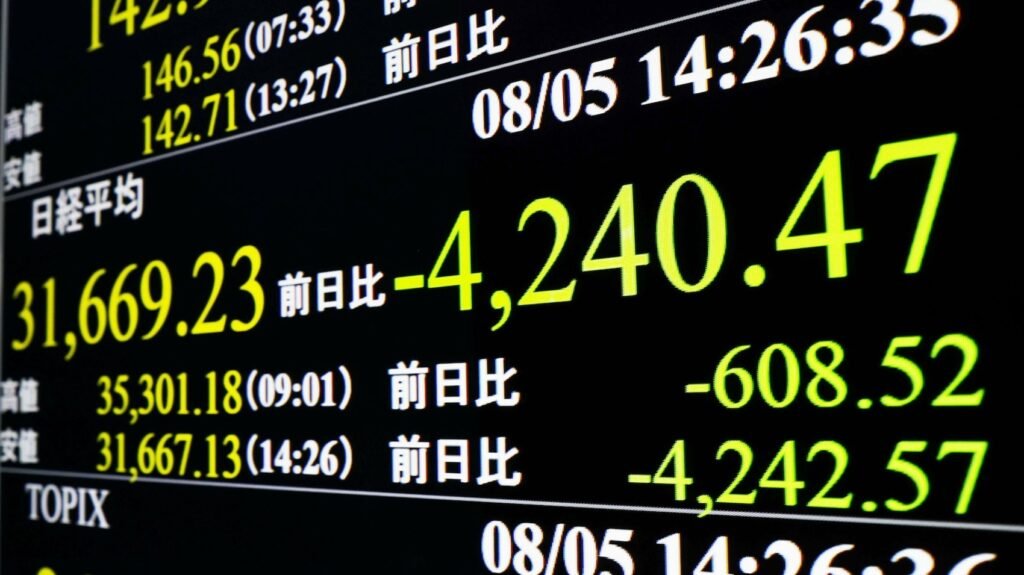
In the Asian market, Hong Kong’s Hang Seng added 0.3% to 17,842.97, while the Shanghai Composite index dropped 0.3% to 2,846.82. Japan’s benchmark Nikkei 225 closed 0.5% higher at 38,288.62. Australia’s S&P/ASX 200 dipped 0.2% to 8,071.20, and South Korea’s Kospi dropped 0.3% to 2,689.15.
In the U.S., the S&P 500 fell 0.3% on Monday, remaining within 0.9% of its record set in July. The Nasdaq composite fell 0.9%, pulled down by several technology companies that tend to tip the market because of their big values. Nvidia lost 2.2%, Microsoft fell 0.8%, Amazon dropped 0.9%, Meta Platforms slid 1.3%, and Tesla lost 3.2%.
The Dow, however, rose 0.2%, to 41,240, eclipsing its previous high set in mid-July. The average is less influenced by Big Tech, with only Apple and Microsoft among the most valuable “Magnificent Seven” stocks in the index. That helped limit the impact of the Big Tech decliners.

Upcoming Economic Indicators and Corporate Earnings
The stock market is coming off a two-week winning streak that’s helped keep the S&P 500 and Dow within striking distance of notching new highs. Monday’s mixed market finish came at the start of a week featuring another full slate of corporate earnings and the government’s latest inflation reading.
A surprisingly good report showed that orders for long-lasting goods from U.S. factories, including cars, jumped 9.9% in July. An update on consumer confidence is on tap for Tuesday and the U.S. will provide a revised estimate on Thursday of economic growth during the second quarter.
Semiconductor company Nvidia reports its latest financial results on Wednesday. It has been a big beneficiary of Wall Street’s mania around artificial intelligence, becoming one of the stock market’s most massive companies, with a total value topping $3 trillion. The stock is up more than 155% for the year.
The key report for investors this week will come on Friday, when the the government serves up its latest data on inflation with the PCE, or personal consumption and expenditures report, for July. It is the Federal Reserve’s preferred measure of inflation.
In conclusion, the global stock market is experiencing a period of mixed performance, influenced by a variety of factors ranging from geopolitical tensions to economic indicators and corporate earnings. Investors and market watchers will be closely monitoring these developments, particularly the upcoming inflation data and corporate earnings reports, to gauge the future direction of the market. This recent market performance echoes historical events where geopolitical tensions and economic indicators have influenced global stock markets. For instance, during the 2008 financial crisis, stock markets worldwide plummeted in response to a housing market crash and subsequent global recession. Similarly, the ongoing trade tensions between the U.S. and China have had significant impacts on global markets, with tariffs and trade restrictions causing fluctuations in stock prices and economic uncertainty.











Post Comment