
Asian Markets Show Mixed Performance Amid Global Uncertainty
Asian Markets Show Mixed Performance Amid Global Uncertainty
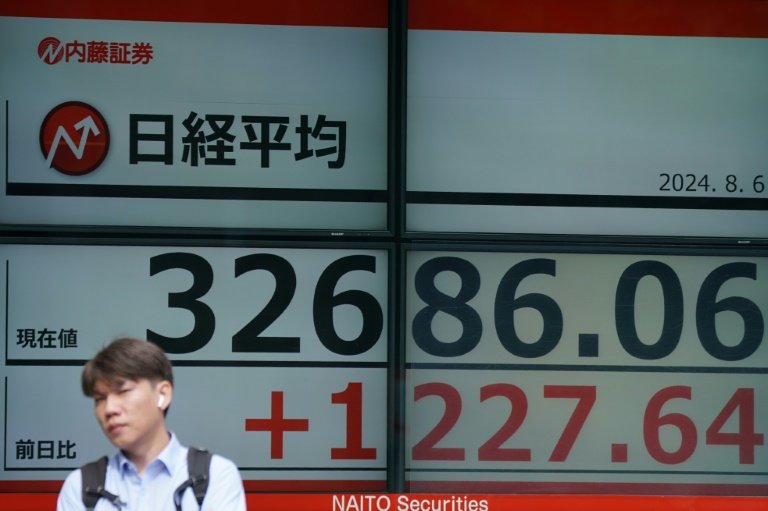
- Asian markets showed mixed performance, with Japan’s Nikkei 225 index recovering by 3.2%.
- The recovery was influenced by the Bank of Japan’s emphasis on stability and a calming of the yen’s volatility.
- Investors are closely watching the U.S. economy, with key data on inflation and retail sales expected this week.
- The mixed performance of global shares reflects a complex interplay of factors, including geopolitical tensions, economic indicators, and central bank policies.
Asian markets experienced a mixed trading day on Tuesday, with Japan’s benchmark Nikkei 225 index making a significant recovery, jumping 3.2% in afternoon trading to 36,156.47. This bounce back was a welcome relief following last week’s plunge, which was the worst since the Black Monday crash of 1987. The recovery was influenced by the Bank of Japan’s emphasis on stability and a slight calming of the yen’s volatility.
In contrast, other Asian markets showed less dramatic movements. Australia’s S&P/ASX 200 rose nearly 0.2% to 7,826.80, while South Korea’s Kospi remained relatively unchanged, gaining less than 0.1% to 2,618.36. Hong Kong’s Hang Seng inched down less than 0.1% to 17,104.82, and the Shanghai Composite lost 0.4% to 2,846.40.
The Tokyo market’s recovery was driven in part by demand for computer chip issues, with Tokyo Electron surging 6.2%. This echoed the strong performance of technology-related issues on Wall Street, indicating a global trend towards tech stocks.
Currency Fluctuations and Global Geopolitical Developments
The yen’s recent volatility also appeared to be calming, which cheered investors. A cheap yen is beneficial for Japan’s major exporters, like Toyota Motor Corp, as it boosts the value of overseas earnings when translated into yen. However, a cheap currency gradually erodes a nation’s purchasing power, posing a long-term challenge to the economy.
On the currency front, the U.S. dollar rose against the Japanese yen to 147.66 yen from 147.17 yen. The euro’s value against the U.S. dollar was little changed, costing $1.0939, compared to $1.0935 previously. Currency analyst at ACY Securities, Luca Santos, noted that global geopolitical developments, such as tensions in East Asia, ongoing conflicts in Eastern Europe, or disruptions in global trade, could further impact the dollar’s performance.
Investors worldwide are also keeping a close eye on the U.S. economy, with key data on inflation and retail sales expected later this week. These indicators are significant because they will influence the Federal Reserve’s decisions on interest rates. A slowdown in inflation could suggest the Fed’s tightening policy is working, potentially easing rate hike concerns. Strong retail sales, on the other hand, indicate a robust economy, which could support higher rates. Both have major implications for market sentiment and the broader economy.
Looking Ahead: Economic Indicators and Market Sentiment
In contrast to the Federal Reserve’s approach, Japan’s central bank is trying to ignite inflation in a long deflation-stuck economy by gradually raising interest rates after years of zero or minus rates. This difference in monetary policy strategies between the two countries highlights the unique economic challenges each faces.
Looking ahead, Japan’s April-June real gross domestic product (GDP), which measures the value of a nation’s products and services, will be released on Wednesday. Some analysts suggest that Japan’s economic growth may be relatively robust, given recent data on domestic capital investment. The stabilization of energy and goods prices has led to the first increase in real wages and real incomes in over two years, which is a positive sign for consumer spending and overall economic health.
On Wall Street, while most stocks weakened, a 4.1% jump for Nvidia helped offset many of those losses. Because it’s one of the largest U.S. stocks by value, Nvidia’s movements carry extra weight on the S&P 500 and other indexes. The S&P 500 rose by less than a quarter of a point, 0.23, to 5,344.39. The Dow dropped 140.53 to 39,357.01, and the Nasdaq composite gained 35.31 to 16,780.61.
Several major U.S. companies, including Walmart and Home Depot, are set to report their earnings results later in the week. Most big U.S. companies have been reporting better profits than analysts expected, which could potentially influence market sentiment.
In conclusion, the mixed performance of global shares on Tuesday reflects a complex interplay of factors, including geopolitical tensions, economic indicators, and central bank policies. As investors navigate this uncertain landscape, they will be closely watching for further developments in these areas. The market’s response to these factors will continue to shape the global economic outlook in the coming days.












Post Comment