Asian Markets Dip as Investors Await Nvidia’s Earnings Report
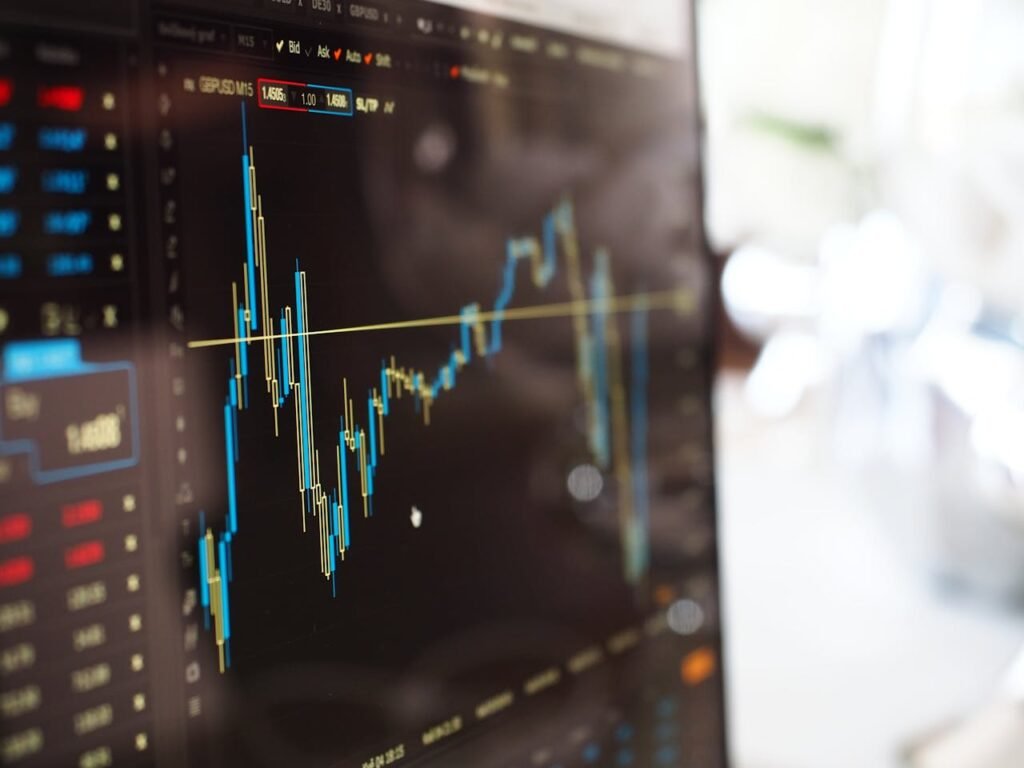
- Asian markets are mostly down as investors await Nvidia’s earnings report.
- Japan’s Nikkei 225 saw a slight increase, and Toyota’s stock jumped 3.7% on potential cooperation with BMW on fuel cells.
- Investors are also watching the Federal Reserve’s expected interest rate cut and the U.S. government’s latest data on inflation.
- The market behavior is reminiscent of historical events where investors have eagerly awaited earnings reports from major tech companies.
Asian markets experienced a mostly downward trend on Wednesday, despite Wall Street reaching a record high. Investors are eagerly awaiting the earnings report from Nvidia, a major player in the tech industry. The company’s total market value has recently surpassed $3 trillion, making it a significant influence on the market. Nvidia’s results are due to be released on Wednesday, and the company has seen a 1.5% rise on Tuesday and a 159% gain this year. Bill Merz, head of capital markets research at U.S. Bank Wealth Management, stated, “That’s the major question, and I think all eyes will be on Nvidia as they report this week. That’s kind of the elephant in the room, so to speak, that many investors will focus on.”
In Japan, the Nikkei 225 saw a slight increase of 0.2% in afternoon trading, reaching 38,352.07. Toyota, Japan’s leading automaker, saw its stock jump 3.7% following reports of a potential cooperative agreement with European automaker BMW on fuel cells. Fuel cell vehicles, which run on electricity produced when hydrogen and oxygen combine to form water, are environmentally friendly. The partnership is expected to be announced next week. Toyota, often criticized for lagging in the global push for electric vehicles, has long been a proponent of fuel cells.
Asian Markets and the Influence of Tech Giants
Australia’s S&P/ASX 200 remained relatively unchanged, inching up less than 0.1% to 8,071.40. The country’s headline index of inflation for July fell less than expected, down 3.5% from the previous year. South Korea’s Kospi declined 0.2% to 2,684.41. Hong Kong’s Hang Seng, which has been steadily rising in recent sessions, dipped nearly 1.0% to 17,700.81. Analysts believe that China’s higher-than-expected industrial profits reported this week are not sufficient to maintain the optimism. The Shanghai Composite dipped 0.6% to 2,832.59.
Investors are also closely watching the Federal Reserve’s expected interest rate cut at its next meeting in September. They are looking forward to Friday when the U.S. government releases its latest data on inflation with the PCE, or personal consumption and expenditures report, for July. On Wall Street, the Dow Jones Industrial Average rose 9 points, or less than 0.1%, marking its second all-time high in two days and an eight-day winning streak. The benchmark S&P 500 and Nasdaq composite each finished 0.2% higher after fluctuating between small gains and losses throughout the day. The S&P 500 is now within 0.8% of its record high set last month. Slightly more stocks closed lower than those that posted gains on the New York Stock Exchange.
Market Performance and Future Expectations
In a positive development, the Conference Board, a business research group, reported that its U.S. consumer confidence index rose to 103.3 in August from 101.9 in July. Consumer spending accounts for nearly 70% of U.S. economic activity. The S&P 500 rose 8.96 points to 5,625.80, the Dow rose 9.98 points to 41,250.50, and the Nasdaq gained 29.05 points to close at 17,754.82.
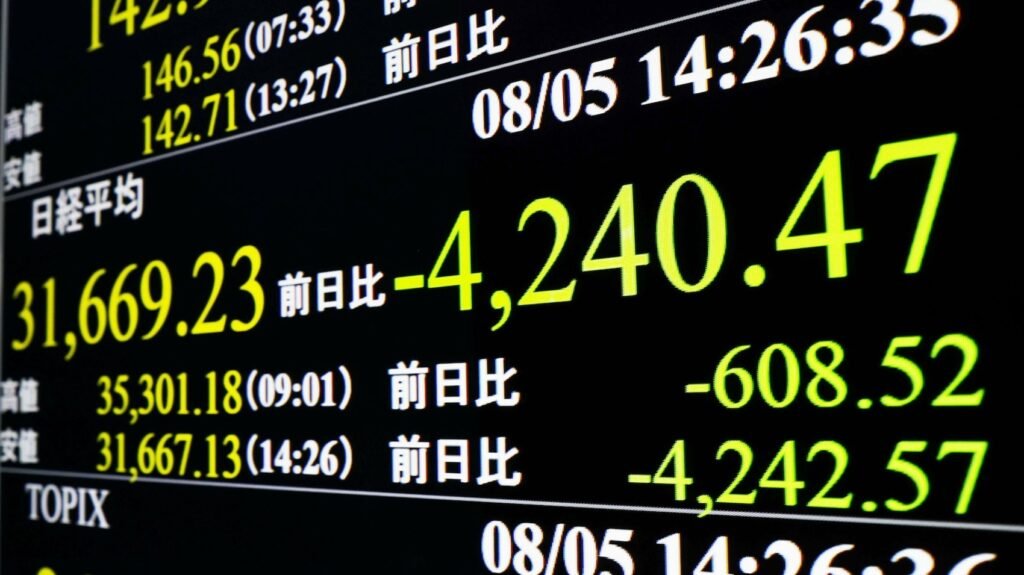
In the bond market, Treasury yields held steady. The yield on the 10-year Treasury rose to 3.83% from 3.82% late Monday. In energy trading, benchmark U.S. crude was unchanged at $75.53 a barrel. Brent crude, the international standard, stood unchanged at $79.55 a barrel. In currency trading, the U.S. dollar rose to 144.53 Japanese yen from 143.91 yen. The euro cost $1.1140, down from $1.1188.
This market behavior is reminiscent of historical events where investors have eagerly awaited earnings reports from major tech companies. For instance, in 2018, the market was closely watching the earnings report from Apple, another tech giant. The company’s report significantly impacted the market, similar to the expected impact of Nvidia’s report. This highlights the influence of major tech companies on global markets.
In conclusion, the Asian markets are mostly declining as investors await Nvidia’s earnings report. Other significant events include Toyota’s potential partnership with BMW on fuel cells and the expected interest rate cut by the Federal Reserve. These events, along with the performance of major indices and stocks, are shaping the current state of the global markets. The anticipation surrounding these events underscores the influence of major tech companies and key economic indicators on market trends.












Post Comment