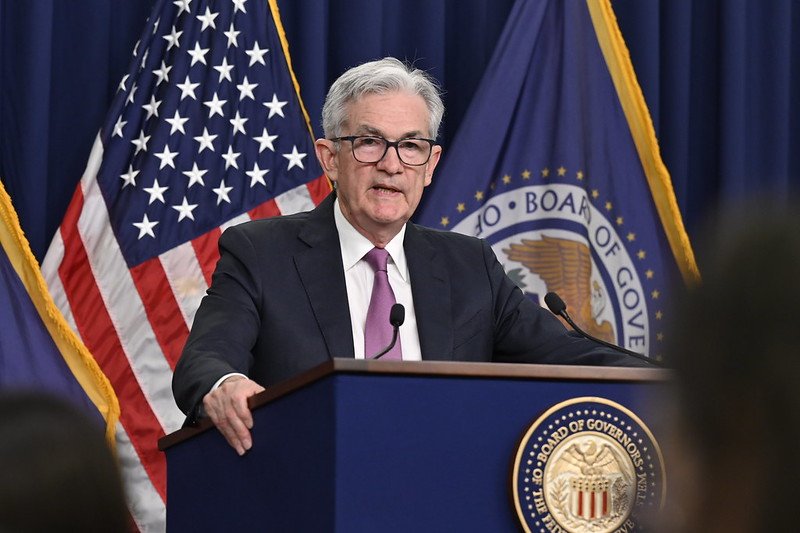
Federal Reserve Slashes Interest Rates Amid Economic Concerns
- The Federal Reserve has cut its benchmark interest rate by a half-point, the first such move in over four years.
- The central bank’s action has brought down its key rate to approximately 4.8%, a significant drop from the two-decade high of 5.3%.
- The Fed’s policymakers plan to cut their key rate by an additional half-point in their final two meetings this year, and foresee more rate cuts in 2025 and 2026.
- The rate cuts are expected to lead to lower borrowing costs for mortgages, auto loans, and credit cards over time, potentially boosting Americans’ finances and stimulating more spending and growth.
In a significant shift from its previous stance, the Federal Reserve has taken a bold step to cut its benchmark interest rate by a half-point. This move, the first of its kind in over four years, marks a departure from the high rates that have been in place for more than two years. These high rates were instrumental in curbing inflation but also resulted in high borrowing costs for American consumers.
The decision to cut the rate is a reflection of the Fed’s new focus on strengthening the job market, which has been showing signs of slowing down. The timing of this move, just weeks before the presidential election, could potentially alter the economic landscape as Americans gear up to cast their votes.
The central bank’s action has brought down its key rate to approximately 4.8%, a significant drop from the two-decade high of 5.3%. The rate had remained at this high for 14 months as the Fed grappled with the worst inflation streak in four decades.
Fed’s New Focus: Bolstering the Job Market
However, inflation has now fallen from a peak of 9.1% in mid-2022 to a three-year low of 2.5% in August, just slightly above the Fed’s 2% target. The Fed’s policymakers have also indicated that they plan to cut their key rate by an additional half-point in their final two meetings this year, scheduled for November and December. They also foresee four more rate cuts in 2025 and two in 2026.
In a statement and a news conference with Chair Jerome Powell, the Fed came closer than ever before to declaring victory over inflation. Powell stated, We know that it is time to recalibrate our (interest rate) policy to something that’s more appropriate given the progress on inflation. He added, We’re not saying, ‘mission accomplished’ … but I have to say say, though, we’re encouraged by the progress that we have made.”
Powell also expressed confidence in the state of the U.S. economy, stating, The U.S. economy is in a good place, and our decision today is designed to keep it there.”
The Impact on American Consumers and the Economy
Despite the central bank’s belief that inflation is largely under control, many Americans are still grappling with high prices for groceries, gas, rent, and other necessities. Former President Donald Trump has blamed the Biden-Harris administration for sparking an inflationary surge. Vice President Kamala Harris, in response, has argued that Trump’s promise to impose tariffs on all imports would further increase prices for consumers.
The rate cuts by the Fed are expected to lead to lower borrowing costs for mortgages, auto loans, and credit cards over time. This could boost Americans’ finances and stimulate more spending and growth. Homeowners will be able to refinance mortgages at lower rates, saving on monthly payments, and even shift credit card debt to lower-cost personal loans or home equity lines. Businesses may also borrow and invest more. Average mortgage rates have already dropped to an 18-month low of 6.2%, according to Freddie Mac, spurring a jump in demand for refinancings.
When questioned at his news conference about whether the Fed’s decision to cut its key rate by an unusually large half-point is an acknowledgement that it waited too long to begin cutting rates, Powell responded, “We don’t think we’re behind. We think this is timely. But I think you can take this as a sign of our commitment not to get behind. We’re not seeing rising claims, not seeing rising layoffs, not hearing from companies that’s something that’s going to happen.”
In conclusion, the Federal Reserve’s decision to cut interest rates is a significant move aimed at bolstering the job market and taming inflation. While the impact of this decision will unfold over time, it is clear that the central bank is committed to maintaining the health of the U.S. economy. As Chair Jerome Powell stated, Our intention with our policy move today is to keep it there.” This move, coupled with the Fed’s future plans, signals a new direction in the central bank’s approach to managing the economy.












Post Comment