The art of making something from nothing
A galaxy of multicolored discs dangles above guests sipping cocktails at Tokyo’s Trunk(Hotel) Cat Street, where the decor comes with an unexpectedly humble origin.
The sculptural forms — made from discarded photo studio backgrounds, pulped and blended with bookbinding glue — are part of Yuko Nishikawa’s “Chromonaut” installation, on view until Sept. 8.
“The use of materials is something I have always been interested in,” the artist says. “Upcycling or introducing the materials in a new form, that kind of transformation is really interesting because there is already a story within the materials.”


Art made from media that could uncharitably be called “trash” creates a strange juxtaposition with luxury spaces such as Trunk’s. However, it’s exactly what many hotels and public-facing businesses are looking for.
Acta+, a sustainability-focused company that matches clients with a network of 500 artists working with discarded materials, has seen strong demand since its founding almost two years ago.
Co-founder and CEO Kiwako Hashimoto says there are two main reasons for the demand for upcycled art.
“Firstly, the hotel thinks the use of sustainable materials is cool,” she says. “The other reason, a softer one, is about projecting the company’s worldview, its desire to create a more sustainable world, through art.”
Last year, Acta+ worked with Orix Hotel Management on an art series under the theme “Make a Circle.” The project was part of Orix’s ongoing effort to promote more sustainable tourism, including through guest experiences.
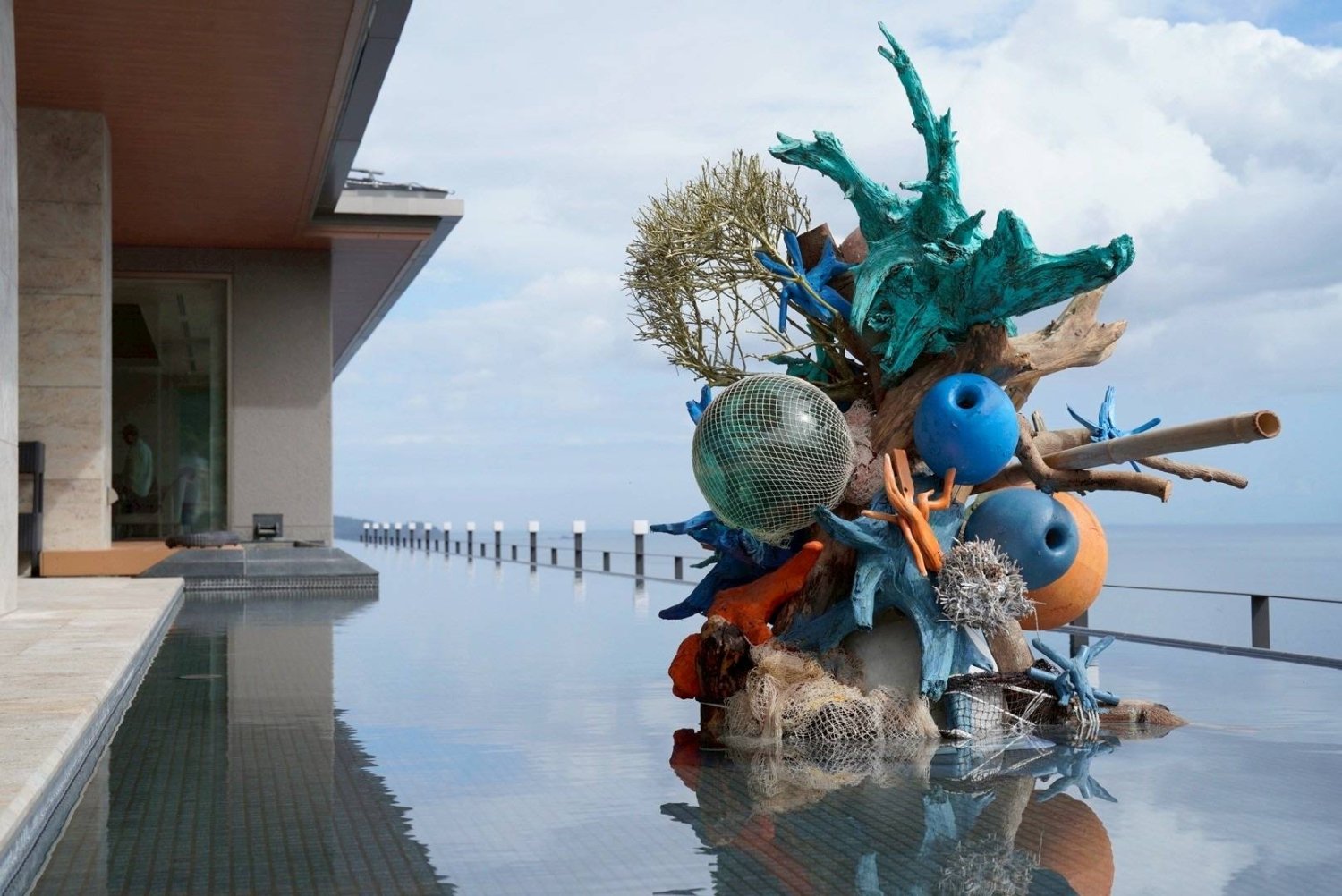
Across 22 directly managed properties, artists highlighted ecological issues affecting local communities by creating temporary installations from castoff materials tied to each area’s crafts and industries. Cracked fishing buoys, discarded sandals, sea urchin shells, scraps of weavers’ threads and more were given pride of place in hotel public areas, visibly connecting the properties to the culture and concerns of the communities.

For hotels, art can do more than signal a commitment to sustainability — it can also give a place a sense of identity.
The Hyatt Centric Kanazawa has invested heavily in local art and design commissions, leaning into Ishikawa Prefecture’s reputation for traditional crafts. Panels of leather used in gold leaf production, offcuts from shamisen making, used paper filters from lacquer refining, silk swatches of Kaga yūzen dye samples and shards of Kutani-ware pottery all make their way into the artworks that fill the hotel, visual signposts clearly marking the location for those that can read them.
“By utilizing waste materials generated during the production process of traditional crafts in Ishikawa, as well as tools and materials that never made it to the public eye, the hotel is creating works of art in a different form,” says Miyuki Murata, Hyatt Centric Kanazawa’s director of marketing communications.
At Hyatt Centric Kanazawa, guests are welcomed on the first floor by “Blacksmith’s Pine Tree,” a massive steelwork depicting one of the famous pines in the city’s Kenrokuen garden. Covered in Ishikawa Prefecture’s famous gold leaf and backed by a deep blue acrylic painting by Yoshinobu Omori, the ornate tree created by artist Atsushi Ozawa exudes refinement. On closer examination, however, the industrial shapes of the components emerge — saws, wrenches, scissors, awls and other discarded tools collected from around the city.


Ozawa, whose works often incorporate salvaged metal, says, “I always want to create works that evoke the smell of the earth, the farming and fishing activities of the region, and the local industries — works that blend together a sense of vibrancy with a contrasting element, something like nostalgia, simplicity or an antique feel.”
Though the motivations of artists and hotels don’t always align, corporate support can provide artists with opportunities to reach new audiences in unconventional spaces different from a gallery or museum.
Artist Noritaka Tatehana agrees that hotels offer a unique chance for communication.
“Hotels offer guests a sense of departure from everyday life, and art can deepen that experience,” he says. “For international visitors in particular, it is meaningful to encounter works that reflect the cultural background and historical context of the place.”
Among Tatehana’s pieces at One Fukuoka Hotel, which opened in April 2025, is “Raiko,” a depiction of the taiko drums held by thunder deity Raijin. The artwork was made from wood salvaged from production at Miyamoto Unosuke Shoten, a taiko manufacturer founded in 1861 and based in Tokyo’s Asakusa neighborhood.
Tatehana says upcycled art is particularly effective because “it involves engaging with the history, memory and prior function embedded within the materials. In that sense, the process becomes a dialogue between past and present.”


For Nishikawa, that sense of the past can be less concrete, even subliminal.
“I believe we have the ability to sense something (from art),” she says. “It could be just in the background, but it creates an environment.
“I really enjoy making art for this kind of active space. People stumble upon the work and it’s really close to their everyday life. I want art to be like that: A part of our life that is not separated from our activities.”
Ozawa, whose works have appeared in hotels including Andaz Tokyo, Tokyo Bay Shiomi Prince and ship hotel Guntu, says he appreciates the unique headspace of the traveler.
“With art, if you take the time to really stop and look, you will find something beyond the first impression,” he says. “It’s like a treasure hunt. Especially in places like hotels, I think the guests are probably more open and relaxed than when out and about in the city. And that openness is a great opportunity for discovery, so I really hope people (encounter my art) with that open spirit.”









Post Comment