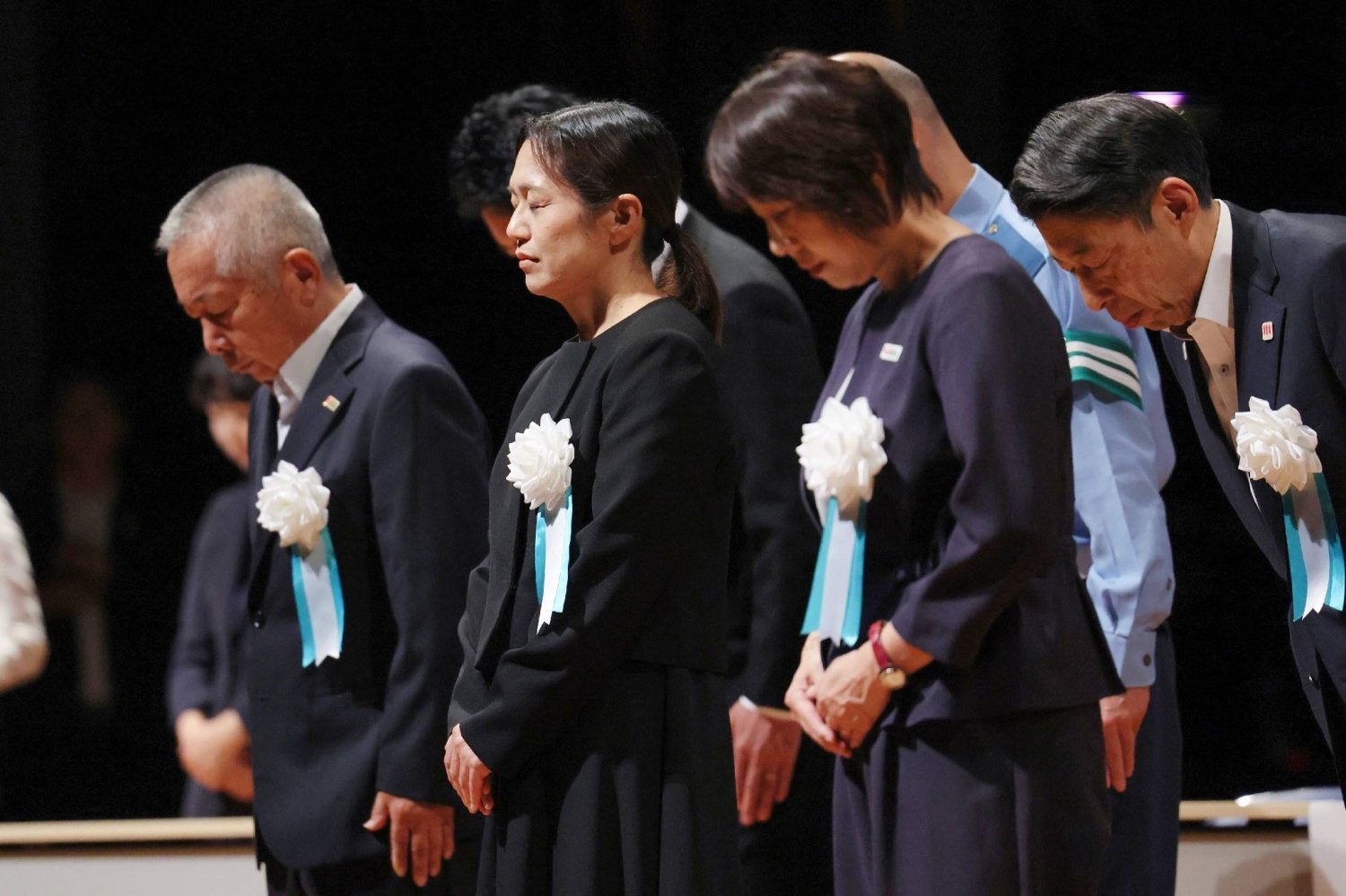
Japan continues work to end drunken driving 20 years after tragedy
Fukuoka Prefecture hosted a conference aimed at eliminating drunken driving in the nation on Tuesday, marking 20 years since a drunken driver rear-ended a car, which then fell off a bridge, killing three small children in 2006.
The incident became one of the turning points for the prefecture and the central government to impose stricter regulations on drunken driving.
“Us adults are the ones who can drive. It is the mission of the adults who create the base for a better society,” said Kaori Onuma, 49, the mother of the three children who died in 2006, on Monday ahead of the anniversary, adding that life should not be cut short because of drunken driving.
Seven prefectural police in the Kyushu region conducted a mass crackdown on drunken drivers on Tuesday. In Fukuoka Prefecture, police will set up about 60 checkpoints.
The tragedy occurred on Aug. 25, 2006, when a drunken driver rear-ended a car carrying a family of five on the Uminonakamichi Bridge in the city of Fukuoka. The car fell into the ocean, killing Onuma’s three children — 4-year-old Hiroaki, 3-year-old Tomoaki, and 1-year-old Saaya.
The drunken driver was sentenced to 20 years in prison for dangerous driving resulting in deaths and injuries. The sentence was finalized in 2011.
Cases of fatalities from drunken driving have rapidly fallen since 2000 as legislation became stricter.
The 1999 death of two children on a Tokyo expressway due to a drunken truck driver led to new laws against dangerous driving, including drunken driving. Subsequent amendments to the Road Traffic Act have added harsher punishments.
According to the National Police Agency, there were 125 drunken driving deaths in 2025, fewer than a tenth of the 2000 figure. Still, accidents involving alcohol were about seven times deadlier than accidents not involving it in 2025.

Stricter enforcement of drunken driving under another amendment of the Road Traffic Act began last month.
Driving after the consumption of any amount of alcohol is against the law in Japan, but it is only a punishable offense when a certain set of criteria is fulfilled.
Under the existing law, those who police deem are unable to drive due to the effects of alcohol — for instance, if the driver is unable to walk straight or slurs when speaking — are charged with the most severe form of drunken driving. Violators face a maximum of five years in prison or a fine of up to ¥1 million ($6,276) for this offense.
The amendment that went into force last month introduces a new numerical threshold for this offense — a breath alcohol content of at least 0.5 milligrams per liter.
The NPA said that the new numerical threshold, for a 60-kilogram person about a half hour after consumption, is equivalent to around two large bottles of beer or 360 milliliters of sake with an alcohol content of 15%.
The legal definition of a less severe form of drunken driving — when the driver’s breath alcohol content is at least 0.15 mg per liter — remains unchanged. The penalty of this offense is up to three years in prison or a fine of up to ¥500,000.
Under the law, those who ride with a drunken driver, those who offer a vehicle to one and restaurant operators who offer a customer alcohol despite knowing the customer would later drive are also held criminally responsible. They can face a maximum of five years in prison or up to ¥1 million in fines depending on how drunk the driver was.
Fukuoka Prefecture, in 2012, established its own ordinance to encourage local residents to report cases of drunken driving. In 2020, the prefecture upgraded the phrasing of the ordinance to make it an “obligation” to report such cases.
Police have also been conducting drills with local restaurants on how to respond and what to keep in mind when reporting such cases to the authorities, such as what the driver looked like and which direction the driver went.
In 2025, a record 2,478 cases of drunken driving were reported to Fukuoka police, of which 235 cases led to the driver being apprehended.













Post Comment